Overview
.jpg?width=700)
Each clear night, hundreds of meteors are visible to the naked eye from any dark location on Earth — the familiar shooting stars caused by dust-grain to pea-sized meteoroids ablating at 11–72 km/s in the upper atmosphere (70–120 km altitude). As the meteoroid heats and vaporizes, collisions between ablated atoms and ambient air molecules strip electrons, creating an elongated cylinder of ionized plasma: the meteor trail. This plasma glows in visible light and strongly scatters radar signals, making meteors both beautiful and scientifically useful.
Our group studies the plasma physics of meteor trails from first principles: how they form, how the plasma diffuses and evolves under gravity and magnetic forces, why some trails develop plasma instabilities that produce dramatically enhanced radar echoes, and how the trail motion can be used to measure winds at altitudes that are otherwise nearly impossible to probe. We combine atomic-scale ablation simulations, massively parallel PIC plasma codes, and high-power radar observations to connect microphysics to observable signatures.
Key Research Topics
Meteor Trail Formation and Diffusion
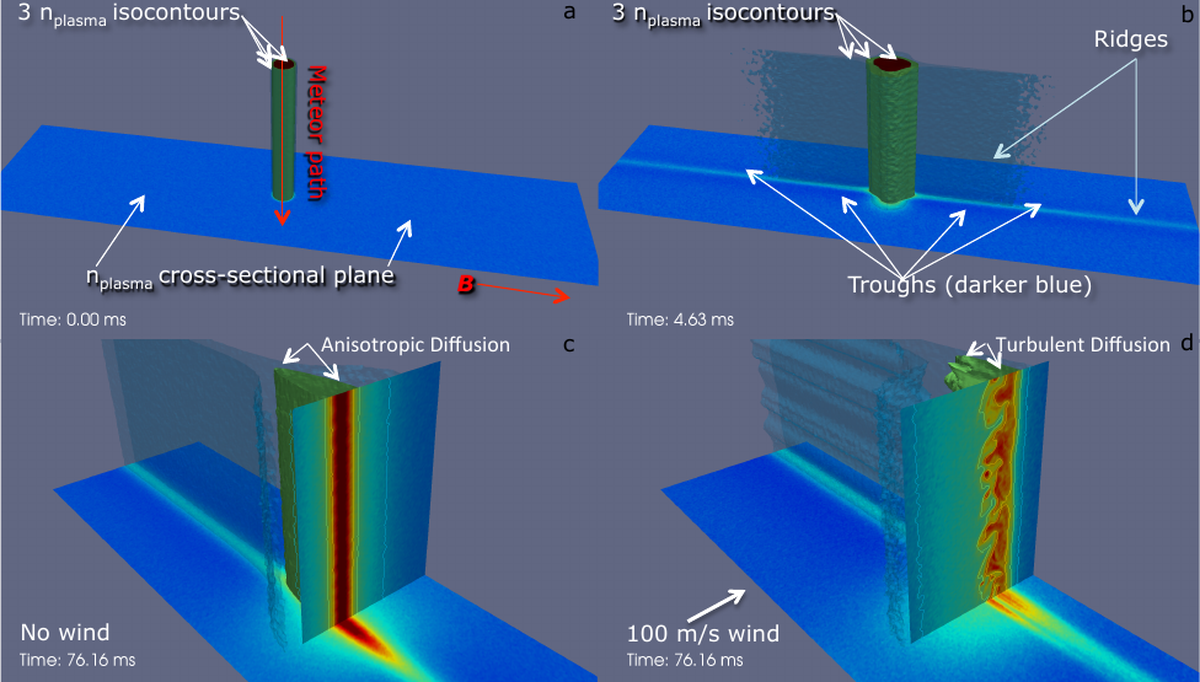
When ablated atoms ionize, the initial plasma column is only centimeters wide, then diffuses outward driven by ambipolar diffusion, geomagnetic forces, and neutral wind shear. We developed analytic theory (Dimant & Oppenheim 2006) and 3D kinetic PIC simulations (Tarnecki & Oppenheim 2021, Oppenheim & Dimant 2015) that predict how the trail evolves from microseconds to minutes. A striking day-to-night asymmetry in trail measurements provided evidence for our new theory of plasma trail evolution (Oppenheim et al. 2008, GRL).
Plasma Instabilities and Nonspecular Echoes
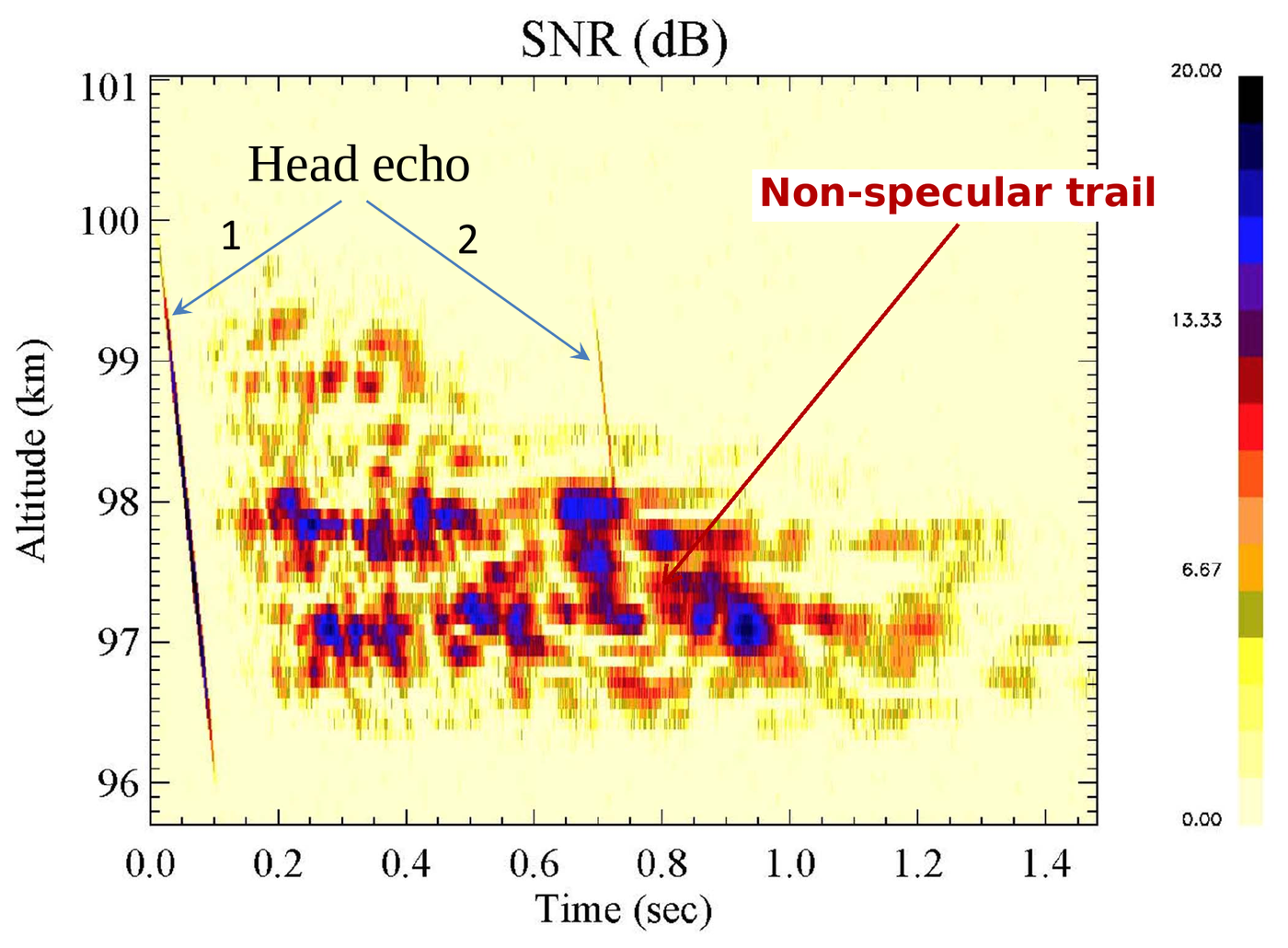
Shortly after formation, many meteor trails develop plasma instabilities driven by field-aligned electron drift. These instabilities generate field-aligned irregularities that scatter radio waves from directions far from the geometrically specular point — the so-called nonspecular trail echoes (NSTEs). Our group pioneered the theoretical explanation for NSTEs (Oppenheim, Dyrud et al. 2003; Dyrud et al. 2002, 2005) and continues to study how the magnetic aspect angle, trail altitude, and electron density govern their detectability (Green & Oppenheim 2025).
Radar Head Echoes and Meteoroid Properties
The plasma sheath surrounding an ablating meteoroid creates a compact, bright radar target — the head echo — that moves with the meteoroid at tens of km/s. High-power radars such as Millstone Hill, ALTAIR, and Jicamarca detect these echoes and measure meteoroid speeds, directions, and deceleration. We develop plasma models of the head echo plasma distribution (Dimant & Oppenheim 2017; Sugar et al. 2018, 2021) and collaborate directly with radar observatories to interpret their measurements (Akharman et al. 2025).
Meteor Winds: Atmospheric Remote Sensing
Meteor trail plasma drifts with the neutral wind in the mesosphere and lower thermosphere (80–105 km) — an altitude region nearly inaccessible to balloons, aircraft, and most satellites. By tracking the Doppler shift and spatial drift of non-specular trail echoes with incoherent scatter radar, our group developed a new technique for measuring MLT wind profiles with unprecedented temporal and spatial resolution. Observations at Jicamarca revealed winds exceeding 500 km/hr and intense vertical shears (Oppenheim et al. 2009, 2014).
Atomic-Scale Ablation Simulations
The plasma that forms a meteor trail ultimately originates from individual atoms and molecules being stripped from the meteoroid surface. We use molecular dynamics simulations (Guttormsen, Fletcher & Oppenheim 2020) to model this ablation process at the atomic scale — tracking how mineral surface layers respond to hypervelocity atmospheric impact, what initial velocity distributions the ablated atoms carry, and how meteoroid composition and rotation affect plasma production (Hedges et al. 2025). These simulations feed directly into our larger-scale plasma evolution models.
Meteoroid Masses, Densities, and Populations
Understanding the meteoroid mass influx to Earth matters for atmospheric chemistry, climate, and planetary science. We developed techniques for determining meteoroid mass and bulk density from radar head echo scattering at multiple frequencies and from trail deceleration measurements (Close et al. 2004, 2012; Bass et al. 2008). Collaboration with Sigrid Close (Stanford) on ALTAIR and Arecibo datasets produced the most detailed radar-based meteoroid mass–velocity distributions available.

Our Computational and Observational Approach
Simulation Approaches: Atoms to Plasma
Step 1 — Atomic scale: Molecular dynamics (LAMMPS) simulations model how the meteoroid mineral surface ablates under hypervelocity impact, producing the initial velocity distribution of ablated atoms and the plasma ionization fraction.
Step 2 — Plasma formation: Direct Simulation Monte Carlo (DSMC) simulations follow the neutral gas dynamics around the ablating meteoroid — how sputtered atoms collide with and disturb the surrounding air — and track the neutrals as they ionize into plasma. Coupled with electromagnetic finite-difference time-domain (FDTD) simulations of the scattered radar wave, this lets us model meteor plasma formation and the resulting head echoes from first principles.
Step 3 — Plasma scale: Massively parallel 2D and 3D PIC simulations then evolve the plasma self-consistently, capturing trail diffusion, instability growth, and the electromagnetic signatures detectable by radar. Hybrid codes (fluid ions / kinetic electrons) allow efficient simulation of the macroscopic trail structure while retaining electron kinetic effects.
 ▶ Play the 3-D simulation movie
Radar Collaborations
We have worked closely with major incoherent scatter radar observatories: Millstone Hill (MIT Haystack), Jicamarca (Peru), ALTAIR (Kwajalein), and PFISR (Alaska). These instruments detect individual meteors in real time at multiple frequencies and aspect angles, providing the observational constraints that validate our simulations. Recent Millstone Hill observations (Akharman et al. 2025) directly test our head echo plasma models.
Optical Meteors (A Promising Direction)
Optical meteor observations complement radar measurements by providing independent constraints on meteoroid entry angle, velocity, and ablation altitude, and the visible glow of a meteor is itself a probe of the plasma chemistry in the trail. Our group's recent work has centered on radar and simulation rather than optical data, but pairing optical measurements with our plasma models is an appealing future direction: it would help close the loop on the meteor ablation process, from the first atoms evaporating off the surface to the final diffusion of the plasma trail. We would welcome students and collaborators interested in pursuing it.
Selected Publications
- Magnetic aspect sensitivity of nonspecular meteor trail echoes
Green, A.Q. & Oppenheim, M.M.; Geophys. Res. Lett., doi:10.1029/2025GL116736, 2025 - Meteor head and trail echo observations by the Millstone Hill radar and comparisons to other measurements
Akharman, M.; Baculima Calle, P.; Oppenheim, M.; Volz, R.; Erickson, P.; J. Geophys. Res.: Space Phys., doi:10.1029/2025JA034212, 2025 - Investigating rotation and anisotropic ablation of small meteoroids and their effects on head echo plasma formation via computational techniques
Hedges, T.; Ferguson, J.C.; Lee, N.; Elschot, S.; Sugar, G.; Oppenheim, M.M.; J. Geophys. Res.: Space Phys., doi:10.1029/2025JA033883, 2025 - Analysis of 3D Kinetic Simulations of Meteor Trails
Tarnecki, L. and Oppenheim, M.; J. Geophys. Res. (Space Phys.), doi:10.1029/2020JA028889, 2021 - Atomic-Scale Simulations of Meteor Ablation
Guttormsen, G.; Fletcher, A.C.; Oppenheim, M.M.; J. Geophys. Res.: Space Phys., doi:10.1029/2020JA028229, 2020 - Simulation-Derived Radar Cross Sections of a New Meteor Head Plasma Distribution Model
Sugar, G.; Marshall, R.; Oppenheim, M.; Dimant, Y.; Close, S.; J. Geophys. Res. (Space Phys.), doi:10.1029/2021JA029171, 2021 - Intense Winds and Shears in the Equatorial Lower Thermosphere Measured by High Resolution Non-Specular Meteor Radar
Oppenheim, M.M.; Arredondo, S.; Sugar, G.; J. Geophys. Res. Space Physics, 119, doi:10.1002/2013JA019272, 2014 - Remote sensing lower thermosphere wind profiles using non-specular meteor echoes
Oppenheim, M.M.; Sugar, G.; Slowey, N.O.; Bass, E.; Chau, J.L.; Close, S.; Geophys. Res. Lett., V.36, doi:10.1029/2009GL037353, 2009 - Formation of plasma around a small meteoroid: 1. Kinetic theory & 2. Implications for radar head echo
Dimant, Y.S. and Oppenheim, M.M.; J. Geophys. Res., 122, doi:10.1002/2017JA023960 & 023963, 2017
Meteor Physics as a Research Area
Meteor physics combines phenomena visible to the naked eye, sophisticated plasma physics, powerful radar observatories, and connections to planetary science and atmospheric chemistry — work at the interface of simulation and observation.
Research in the group runs through the BU Astronomy PhD program: bu.edu/astronomy/graduate.